



A Practical Guide for Established DTC Brands Entering Amazon.com
The right U.S. Amazon agency should be able to evaluate market demand, model channel economics, prepare listings, coordinate inventory, manage advertising, monitor account health, and clearly define who owns each commercial decision.
For an international brand, choosing a partner is not simply a marketing decision. It determines how the U.S. Amazon channel will be structured, operated, measured, and held accountable.
A brand may already have successful products, established customer demand, and a strong direct-to-consumer business. Those advantages provide a useful foundation, but they do not automatically answer the operational questions involved in entering Amazon.com:
- Who will own the Amazon account?
- Who will import and hold inventory?
- How will inventory reach Amazon FBA?
- Who will manage listings, advertising and pricing?
- Who will monitor account health and replenishment?
- How will the brand measure contribution margin?
- Who will be accountable for overall channel performance?
This guide explains how an international brand should evaluate an Amazon agency, distributor, or operating partner before entering the United States.
Start by Defining the Support You Need
Before comparing providers, determine which responsibilities the external partner will need to assume.
Some brands already have an internal marketplace team and need specialist support with Amazon advertising, listing optimization, localization, or launch preparation. Other brands require a partner capable of coordinating the entire Amazon channel.
The required scope may include:
- U.S. market and category assessment
- Channel economics and margin modeling
- Seller Central setup or account management
- Product and listing localization
- Amazon Brand Registry support
- Inventory and FBA coordination
- Amazon advertising
- Pricing and promotional planning
- Account health and brand protection
- Reporting and commercial analysis
- Ongoing channel strategy
A provider can be highly capable in one area without being equipped to manage the full channel. Brands should therefore decide whether they need a specialist, traditional agency, distributor, or operating partner before evaluating individual companies.
What Is the Difference Between an Amazon Agency, Distributor and Operating Partner?
These terms can describe substantially different commercial relationships.
None of these models is automatically better. The right choice depends on the brand’s economics, internal capabilities, desired control, working capital, inventory structure and preferred level of partner responsibility.
1. Look for Relevant International Experience
An international brand faces responsibilities that a domestic Amazon seller may not encounter in the same way.
U.S. market entry can involve:
- International freight
- Customs clearance
- Importer responsibilities
- Product preparation and labeling
- U.S. inventory storage
- Amazon FBA replenishment
- Tax considerations
- Product and category compliance
- Returns and reverse logistics
An Amazon agency should not replace qualified legal, tax, customs or compliance advisers. However, an experienced partner should understand when those specialists are needed and how their decisions affect the Amazon operating plan.
Amazon’s Global Selling resources explain how businesses outside the United States can sell to U.S. customers. Creating an account is only one part of building a viable Amazon channel.
Ask prospective partners:
- Which international launches have you supported?
- Which product categories do you understand?
- Which responsibilities did you manage?
- Which responsibilities remained with the brand?
- How did you coordinate logistics, inventory and marketplace execution?
Relevant experience matters more than a general claim that the agency works with Amazon sellers.
2. Expect a Market and Channel Economics Assessment
A credible partner should not recommend entering Amazon USA simply because the brand performs well in another market.
The assessment should consider:
- U.S. category demand
- Relevant search behavior
- Competitive density
- Customer expectations
- Typical retail pricing
- Review patterns
- Product differentiation
- Landed costs
- Amazon selling and fulfillment fees
- Advertising investment
- Storage and returns
- Promotional discounts
- Partner or distribution margins
The objective is to determine whether the brand has a realistic path to visibility, conversion and sustainable economics.
Revenue projections alone are insufficient. A product can generate sales while producing an unattractive contribution margin after freight, fulfillment, advertising, discounts, returns and partner costs are included.
Our guide to launching an international brand on Amazon USA explains the broader market-entry process. When choosing an agency, the important question is whether the provider can evaluate and operate that process rather than merely complete an account setup.
A strong partner should also be prepared to recommend against a launch when the economics, product positioning or operating structure are not ready.
3. Understand the Proposed Operating Model
The partner should explain exactly how the relationship will work before the engagement begins.
Under a traditional agency model, the brand normally retains ownership of its Seller Central account, inventory, pricing and revenue. The agency operates within an agreed scope.
Under a full-channel Brand Management model, the brand can retain account and inventory ownership while the operating partner coordinates strategy, listings, advertising, reporting, inventory, account health and ongoing execution.
Under a Wholesale Partnership, the partner may purchase inventory and assume greater responsibility for channel execution, sell-through and marketplace operations.
The decision should consider:
- Account ownership
- Inventory ownership
- Pricing control
- Revenue flow
- Data access
- Brand Registry permissions
- Working-capital requirements
- Internal Amazon expertise
- Available operational capacity
- Margin expectations
- Exit and transition procedures
Brands should avoid relationships where account access, data ownership or operational responsibility remain unclear.
If the brand is still deciding between different Amazon structures, see our comparison of Seller Central, Vendor Central and a U.S. operating partner.
4. Evaluate Full-Channel Capabilities
Advertising is important, but it cannot compensate for unavailable inventory, weak listings, poor pricing, suppressed content or unresolved account issues.
A partner supporting U.S. market entry should explain how advertising connects with:
- Retail readiness
- Listing quality
- Conversion performance
- Inventory coverage
- FBA replenishment
- Pricing and promotions
- Contribution margin
- Account health
- Brand protection
- Reporting and forecasting
Ask what happens when these functions affect one another.
If inventory is running low, will advertising activity be adjusted? If conversion declines, who will investigate the listing, pricing, reviews and competitive environment? If a product is suppressed, who owns the resolution and communicates the commercial impact?
The strongest partner is not necessarily the one with the longest service list. It is the one with a clear process for connecting decisions across the channel.
The Amazon Partner Evaluation Framework
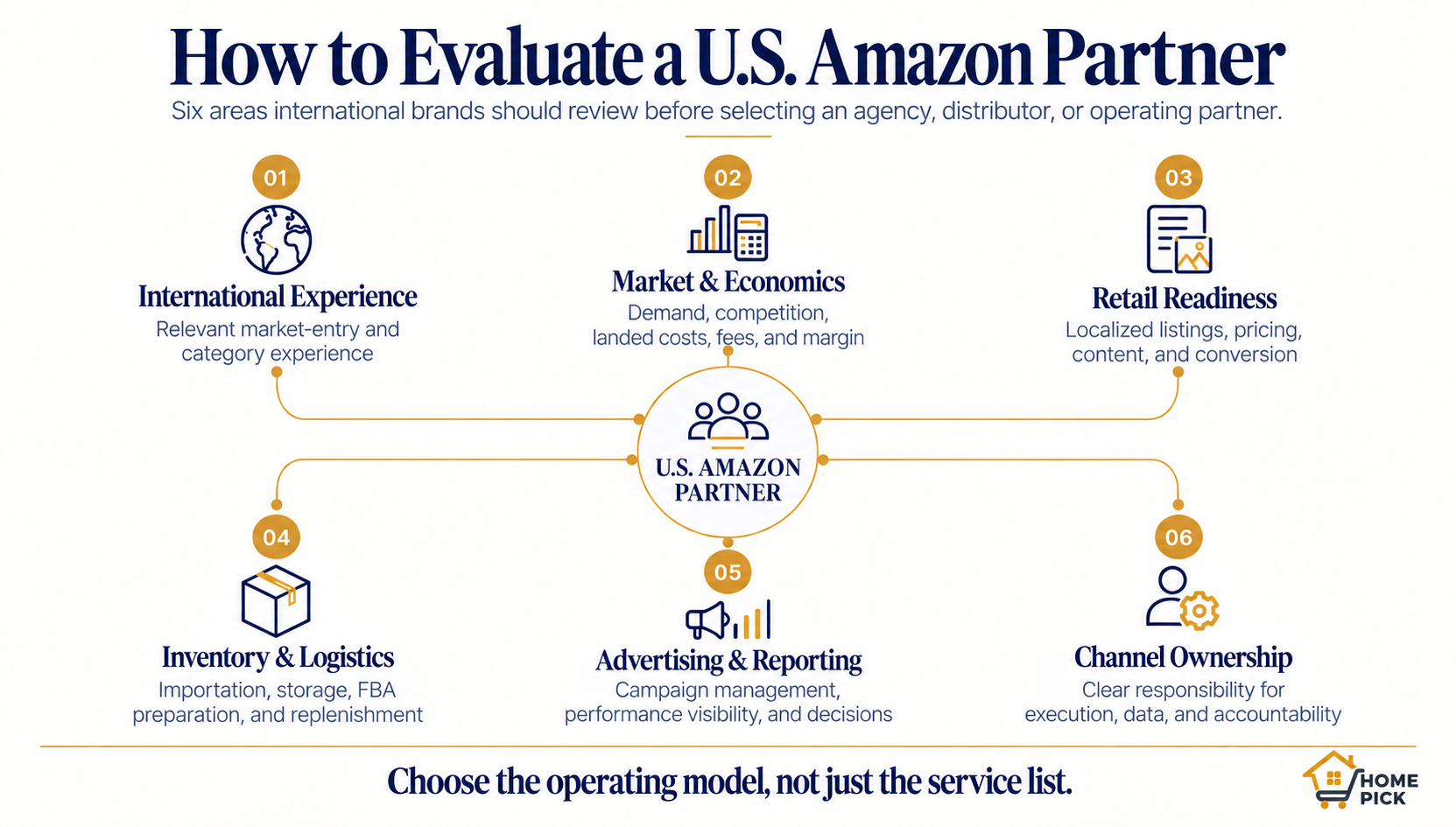
An international brand should evaluate every potential partner across six connected areas:
1. Market opportunity: Is there sufficient demand and a defensible competitive position?
2. Channel economics: Can the products support Amazon fees, advertising, logistics and partner costs?
3. Retail readiness: Are the listings, pricing, content, reviews and product claims ready for the U.S. market?
4. Inventory and logistics: Can the brand maintain compliant and reliable inventory availability?
5. Advertising and growth: Can the partner build demand without separating advertising from profitability and stock position?
6. Channel ownership: Are decisions, responsibilities, data access and accountability clearly assigned?
A weakness in one area can limit the performance of the others.
5. Examine Reporting and Commercial Visibility
A prospective partner should demonstrate how the brand will understand what is happening after launch.
Reporting may need to cover:
- Revenue and unit sales
- Advertising performance
- Total advertising cost of sales, commonly called TACoS
- Conversion
- Inventory coverage
- Pricing and promotions
- Returns
- Product-level performance
- Account health
- Margin indicators
- Risks, actions and decision owners
Ask to see a sample reporting structure with confidential client information removed.
More importantly, ask what happens after the report is delivered. A dashboard is not a management process.
The partner should explain:
- How frequently performance is reviewed
- Who interprets the results
- How priorities are established
- Who owns each action
- How unresolved issues are escalated
- How commercial decisions are documented
Reporting should connect marketplace activity with decisions about margin, inventory, advertising and growth.
6. Ask for Evidence That Matches the Proposed Work
Testimonials and client logos can support credibility, but they do not always prove that the provider has completed the work your brand requires.
Ask for evidence related to:
- Your product category
- International market entry
- Similar operational complexity
- Comparable catalog size
- The services being proposed
- The commercial model under consideration
Evidence does not need to expose confidential information. A useful example can explain:
- The client’s starting position
- The problem being addressed
- The timeframe
- The actions taken
- The result
- The context or limitations surrounding that result
Brands can also review Amazon’s Service Provider Network. Amazon describes the network as a directory of vetted third-party providers and allows sellers to filter by service, location, language and reviews.
Amazon also states that these listings are informational and do not constitute an endorsement of any particular provider. Brands should still conduct their own commercial and operational evaluation.
7. Evaluate How the Partner Will Work With Your Team
Amazon execution rarely happens in isolation.
The external partner may need to coordinate with leadership, finance, supply chain, marketing, logistics providers, compliance advisers and internal ecommerce teams.
Before selecting a provider, establish:
- Who will be the principal point of contact?
- Which decisions require brand approval?
- How quickly should each party respond?
- Who provides inventory and financial information?
- Who approves pricing and promotional changes?
- How will urgent marketplace issues be handled?
- How often will operating and commercial reviews occur?
- What happens if priorities change?
The quality of the operating relationship matters as much as the service list. A capable partner still needs timely information, clear decision rights and active collaboration from the brand.
Questions to Ask Before Choosing an Amazon Partner
Use these questions during the evaluation process:
1. What experience do you have with international brands entering the United States?
2. Which categories and business models do you understand best?
3. How do you assess market opportunity and channel economics?
4. Who will own the Amazon account, inventory, pricing and revenue?
5. Which responsibilities remain with our internal team?
6. How do advertising, listings, inventory and reporting work together?
7. How will contribution margin and commercial performance be reviewed?
8. Who handles urgent account, listing or inventory issues?
9. Can you provide relevant and verifiable examples?
10. What will happen during the first 90 days?
11. How will data, permissions and account access be managed?
12. What would make our brand a poor fit for your model?
Clear answers are more valuable than an impressive presentation.
Warning Signs When Evaluating an Amazon Agency
Be cautious when a provider:
- Guarantees rankings, revenue or immediate profitability
- Recommends advertising before assessing retail readiness
- Cannot explain inventory and logistics responsibilities
- Focuses on revenue without discussing margin
- Uses the same launch plan for every product category
- Cannot identify who owns daily execution
- Avoids questions about account, data or Brand Registry access
- Provides reports without a decision-making process
- Pushes a full-catalog launch without prioritization
- Cannot provide relevant examples
- Cannot explain when its service would be a poor fit
A strong partner should be willing to identify risks, challenge assumptions and explain what must be resolved before the brand invests in inventory or advertising.
When Home Pick May Be the Right Fit
Home Pick is an Amazon growth operating partner for established consumer brands.
We help brands manage Amazon as a connected revenue channel by bringing together:
- Amazon strategy
- Market and category assessment
- Retail readiness
- Catalog and listing management
- Advertising
- Inventory and logistics coordination
- Reporting
- Account health
- Brand protection
- Ongoing channel management
Depending on the opportunity, brands can work with Home Pick through Brand Management or a Wholesale Partnership.
Home Pick may be a strong fit when a brand has differentiated products, existing demand, credible U.S. market potential and a willingness to collaborate on the operating plan.
Home Pick may not be the right fit for a company seeking only the lowest-cost PPC provider, a one-time listing project, or guaranteed results without the operational work required to support them.
Learn more about how Home Pick operates and grows Amazon brands.
Frequently Asked Questions
What should an international brand look for in a U.S. Amazon agency?
An international brand should look for relevant market-entry and category experience, clearly defined responsibilities, inventory and logistics awareness, retail-readiness expertise, advertising capabilities and transparent commercial reporting. The provider should explain how these functions work together and who will be accountable for the overall channel.
What is the difference between an Amazon agency and an operating partner?
An Amazon agency normally manages a defined service scope such as advertising, listings or account management. An operating partner coordinates a broader set of commercial and operational responsibilities across strategy, inventory, listings, advertising, reporting and channel performance.
Should an international brand use an agency, distributor or operating partner?
The right model depends on how much control and responsibility the brand wants to retain. An agency typically manages agreed services, a distributor purchases and resells inventory, and an operating partner can coordinate the broader channel through a management or wholesale structure.
Should the brand retain ownership of its Seller Central account?
Under a Brand Management model, the brand will generally want appropriate control over its Seller Central account, data, permissions and intellectual property. Wholesale relationships can use a different structure. Ownership, access and transition procedures should be documented before the engagement begins.
Can an Amazon agency handle U.S. product compliance and taxes?
An agency may help coordinate the process and identify where specialist advice is required. Legal, tax, customs and product-compliance obligations should be confirmed with qualified professionals because requirements depend on the company, product and operating structure.
How can a brand verify an Amazon agency’s experience?
Request examples that match the proposed work. Look for a clear starting point, timeframe, actions and outcome, supported where possible by references, verified reviews, sample reporting or other evidence.
When should an international brand choose its Amazon partner?
Ideally, the partner should be selected before the brand commits substantial inventory or advertising budget. The partner can then help evaluate market demand, channel economics, the operating model, retail readiness and logistics before launch execution begins.
How long should a brand evaluate an Amazon agency before signing?
There is no universal evaluation period. The brand should take enough time to review the proposed scope, responsibilities, evidence, economics, account access and commercial terms before making a decision. Complex international or wholesale arrangements may require additional legal, tax and logistics review.
Evaluate Your U.S. Amazon Opportunity
Choosing a U.S. Amazon partner should begin with the market opportunity, channel economics and operating responsibilities—not a generic service package.
Home Pick helps established and international brands evaluate, enter and operate the U.S. Amazon marketplace through a connected operating model.
Schedule an Amazon Strategy Call to discuss your U.S. market opportunity and determine whether Home Pick is the right operating partner for your brand.


