


An effective Amazon growth strategy for 2027 should connect revenue expectations to product priorities, unit demand, contribution margin, inventory capacity, advertising investment, and operating ownership. If those elements are planned separately, the result may be an ambitious forecast that the channel cannot support.
For established brands, the objective is not to predict one perfect revenue number. It is to define what must be true for growth to happen, identify the constraints that could prevent it, and establish decision points before the full budget is committed.
Revenue Ambition Is Not an Amazon Growth Strategy
A revenue target communicates where the business wants to go. It does not explain how the Amazon channel will get there.
Leadership may establish a growth objective based on broader company plans, category expectations, or prior-year performance. But the Amazon team still needs to translate that ambition into operational requirements.
A credible plan should answer:
- Which ASINs are expected to produce the growth?
- How many units must each product sell?
- Does the expected price and promotional plan support the required contribution?
- Is enough inventory available or scheduled?
- How much advertising investment will be required?
- Are the listings and offers ready to convert additional traffic?
- Can the team execute the plan and respond when performance changes?
If those questions cannot be answered, the target remains an aspiration rather than an operating plan.
A practical planning sequence looks like this:
Revenue target → ASIN priorities → Unit forecast → Economics → Inventory → Advertising → Operating capacity → Decision gates
Each stage either supports the target or reveals a constraint that needs to be resolved.
Start With an Amazon Sales Forecast, Not a Revenue Wish
An Amazon sales forecast should be built from channel evidence rather than assigned as a simple percentage increase over the previous year.
Begin with a realistic baseline. Review recent sales velocity, seasonality, pricing, availability, traffic, conversion, promotional periods, and meaningful changes in the assortment. Historical performance is useful, but it should not be copied forward without context.
For example, a temporary sales increase caused by deep discounting should not automatically become the new baseline. Neither should a period affected by stockouts be treated as a reliable measure of demand.
A useful forecast should include at least three scenarios:
- Base scenario: What the current channel is likely to produce without major changes.
- Target scenario: What could reasonably be achieved if the planned initiatives perform.
- Upside scenario: What may be possible if demand, conversion, inventory, and execution outperform expectations.
The assumptions behind each scenario matter more than the labels. Leadership should be able to see what changes between them: unit demand, pricing, promotional intensity, advertising investment, conversion, inventory requirements, or new-product contribution.
This makes the forecast useful for decisions. If performance begins to move above or below plan, the team can identify which assumptions changed and adjust accordingly.
Translate the Forecast Into Product Priorities
Channel-level growth does not happen evenly across every product.
A stronger Amazon growth plan assigns a clear role to each priority ASIN. This prevents the team from spreading inventory, advertising, and creative resources across products with different commercial value.
Products may be grouped into four practical roles:
This is not a permanent classification. A product may move from testing into core growth if demand and economics become credible. A core product may become constrained if inventory coverage deteriorates or contribution weakens.
The purpose is to make investment decisions explicit. Every material ASIN should have a commercial role, an expected contribution, and a defined reason for receiving resources.
Connect Growth Targets to Contribution and Margin
Revenue growth is not enough if the additional sales weaken the economics of the channel.
For each priority product, the planning model should connect expected sales with:
- Selling price
- Promotional discounts
- Cost of goods
- Freight and landed costs
- Amazon referral and fulfillment fees
- Preparation and storage costs
- Advertising spend
- Returns or other relevant operating costs
- Expected contribution after those costs
The purpose is not to produce a false level of precision. Costs and performance will change. The purpose is to establish acceptable commercial boundaries before spending begins.
Leadership should define:
- The minimum contribution expected from core products
- The acceptable investment period for new or strategic products
- The conditions under which higher advertising spend is justified
- The point at which promotions become commercially unattractive
- The products that should not be scaled even if revenue is increasing
This prevents the team from treating every sales increase as healthy growth.
A product that generates more revenue through deeper discounts and rapidly rising advertising costs may not be creating more value. The plan should make that visible early.
Build Inventory Forecasting Into the Growth Plan
An Amazon inventory forecast converts the sales plan into units, timing, and replenishment requirements.
For each priority ASIN, the team should understand:
- Current sellable inventory
- Confirmed inbound inventory
- Expected weekly or monthly unit demand
- Manufacturing and supplier lead times
- Freight and receiving timelines
- FBA preparation and check-in time
- Reserve inventory outside FBA
- Reorder points
- Ownership of replenishment decisions
The forecast should also reflect the different demand scenarios. A target forecast may be commercially attractive but impossible to support if production capacity or replenishment timing cannot keep pace.
The opposite risk also matters. Ordering inventory against an upside scenario before demand is proven can tie up cash and increase storage exposure.
Effective Amazon inventory planning therefore connects purchasing decisions to evidence and decision gates. Inventory can be released in stages when the supply chain allows it, rather than committing the full annual requirement based on one forecast.
For a broader review of inventory, listings, advertising, account health, and ownership, see Home Pick’s guide to Amazon channel readiness before peak season.
Set an Advertising Budget the Economics Can Support
Amazon advertising budget planning should begin with the role of the product and the economics of the plan—not with a blanket percentage increase.
A practical budget structure separates three types of investment:
Protect proven demand
Allocate sufficient budget to campaigns and search terms that consistently support commercially valuable products. The objective is to protect visibility without assuming that every additional dollar will produce the same return.
Support defined growth opportunities
Increase investment where the product has credible demand, strong retail readiness, sufficient inventory, and acceptable contribution. These campaigns should be connected to the target scenario and monitored against the assumptions used in the plan.
Fund controlled exploration
Reserve a defined test budget for new products, new audiences, keywords, placements, or campaign structures. Exploratory spending should have an owner, a purpose, an evaluation period, and a decision rule.
This structure makes Amazon PPC budget planning more accountable. It prevents experimental spending from quietly consuming the budget required by proven products, while still allowing the brand to discover new growth opportunities.
The advertising plan should also specify what happens when conditions change. If inventory becomes constrained, conversion declines, or contribution falls below the approved level, the team should know whether to reduce, redirect, maintain, or stop spending.
Confirm the Operating Capacity Behind the Plan
Growth creates additional work across the Amazon channel.
More products, campaigns, promotions, and inventory movements require faster decisions and stronger coordination. A plan can be financially viable and still fail because no one owns the execution.
Before approving the annual target, confirm who is responsible for:
- Product and ASIN prioritization
- Listing and catalog improvements
- Pricing and promotional coordination
- Advertising decisions
- Inventory forecasting and replenishment
- Account health and compliance
- Performance reporting
- Financial reconciliation
- Cross-functional approvals
- Escalation when results move away from plan
The operating rhythm also matters. A quarterly strategy cannot rely on teams discovering problems only at the end of the quarter.
Priority products and material risks should be reviewed frequently enough to support action. Reports should show what changed, why it matters, what decision is required, and who owns the next step.
If the brand still has to coordinate disconnected agencies, logistics partners, advertising specialists, and internal teams, operating capacity may become the real growth constraint.
Home Pick’s Amazon account management test explains how strategy, advertising, inventory, reporting, and ownership should work within one connected channel model.
Use Decision Gates Instead of Committing the Full Plan at Once
An annual plan should define the direction for the year without pretending that every decision can be made in advance.
Decision gates allow the brand to increase commitment as evidence improves.
A decision gate may review:
- Sales performance against the relevant scenario
- Contribution and margin
- Inventory coverage and inbound status
- Conversion and retail readiness
- Advertising efficiency and incremental opportunity
- Customer feedback and returns
- Required operational capacity
- Risks that could limit the next growth stage
The outcome should lead to one of four actions:
- Scale: Increase inventory, advertising, or promotional support.
- Maintain: Continue the current plan while gathering more evidence.
- Redirect: Move resources toward products or activities with stronger potential.
- Stop or rework: Address a fundamental constraint before investing further.
This approach is more useful than approving the full annual budget and waiting for performance to justify it afterward.
Build a Capacity-Based Amazon Growth Planning Framework
A capacity-based framework connects the revenue objective to the resources and conditions required to deliver it. It also gives leadership a clear view of where the plan is strong, where assumptions remain uncertain, and where investment should be conditional.
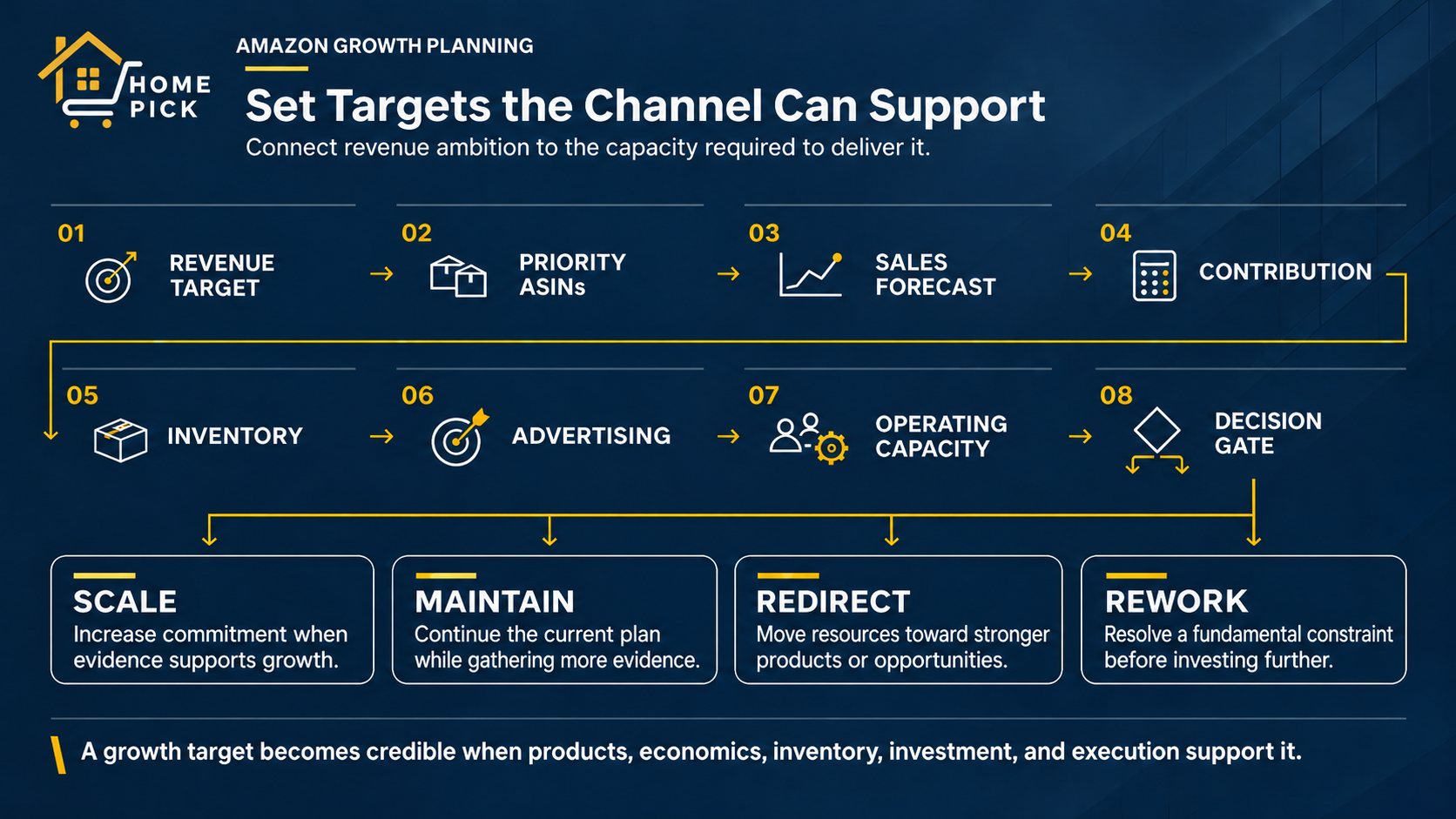
This table turns annual planning into a management system rather than a static forecast.
What Leadership Should Approve for 2027
Before the plan is finalized, leadership should approve more than the headline revenue number.
The final Amazon channel strategy should document:
- The target and the assumptions behind it
- The products expected to produce the growth
- The required inventory and replenishment capacity
- The expected contribution and acceptable commercial limits
- The planned advertising investment and test budget
- The teams and owners responsible for execution
- The cadence for reviewing performance and risks
- The decision gates for releasing additional investment
This gives the Amazon team clear direction while allowing the plan to adapt as evidence changes.
It also makes tradeoffs visible. If leadership wants a higher target, the business can see whether that requires more inventory, stronger listings, greater advertising investment, additional operating support, or a different product mix.
Plan the Channel the Business Can Actually Operate
The strongest Amazon growth plan is not the one with the highest forecast. It is the one that connects commercial ambition to the products, economics, inventory, investment, and operating capacity required to deliver it.
For 2027, established brands should avoid treating sales forecasting, inventory planning, PPC budgeting, and channel execution as separate exercises. They are parts of the same operating plan.
When those decisions are connected, leadership can invest with greater clarity, respond earlier when assumptions change, and scale the parts of the channel that have the strongest evidence behind them.
Home Pick helps established brands connect Amazon strategy, listings, advertising, inventory coordination, account health, and reporting through one accountable operating model. Explore Home Pick’s Amazon services or schedule an Amazon Strategy Call to discuss what your 2027 channel plan needs to support.
Frequently Asked Questions
What should an Amazon growth strategy include?
An Amazon growth strategy should connect revenue objectives to product priorities, unit demand, contribution margin, inventory requirements, advertising investment, retail readiness, operating ownership, and decision gates. It should explain how growth will happen, what resources it requires, and what evidence is needed before additional investment is approved.
How do you forecast Amazon sales?
Start with recent product-level sales velocity, seasonality, pricing, availability, conversion, promotions, and known assortment changes. Build base, target, and upside scenarios, then document the assumptions behind each one. Convert the forecast into units by ASIN so inventory, advertising, and contribution can be evaluated against the same plan.
How should a brand plan Amazon inventory for growth?
Translate the unit forecast into inventory requirements by product and period. Include current sellable stock, inbound inventory, manufacturing and freight lead times, preparation, Amazon receiving, reserve stock, and replenishment ownership. Inventory commitments should reflect multiple demand scenarios rather than one optimistic forecast.
How much should a brand budget for Amazon advertising?
There is no universal percentage that works for every brand. The budget should reflect product margin, inventory, retail readiness, category competition, organic demand, growth objectives, and the role of each ASIN. Separate funding for proven demand, defined growth opportunities, and controlled tests.
How often should an Amazon growth plan be reviewed?
The annual direction should remain visible throughout the year, but product performance, inventory risks, advertising, and contribution should be reviewed more frequently. The appropriate cadence depends on the brand’s scale and volatility. Reviews should happen often enough for the team to act before a risk becomes a larger commercial problem.


