


The agency manages PPC. Someone else updates the listings. The operations team monitors inventory. Finance reviews margin. Leadership receives a dashboard.
Yet whenever something goes wrong, the brand still has to identify the problem, bring everyone together, assign the work, and follow up until it is resolved.
That is not complete Amazon account management. It is a collection of services that the brand is still responsible for managing.
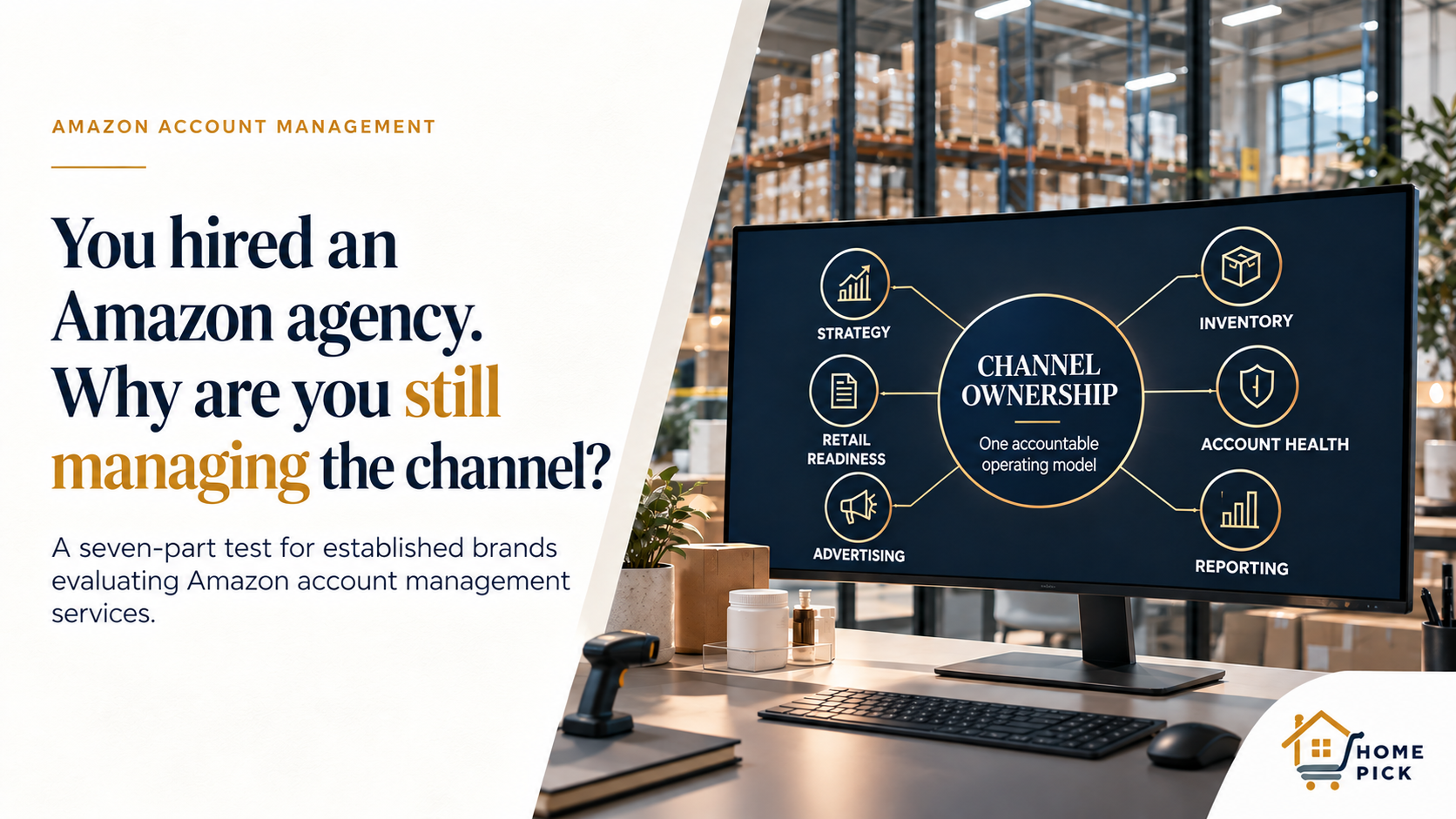
Effective Amazon account management services should connect strategy, retail readiness, advertising, inventory, account health, reporting, and decision-making within one operating model. The goal is not to remove the brand from the process. It is to create clear ownership so leadership no longer has to coordinate every part of the channel.
The Hidden Problem With “Full-Service” Amazon Management
“Full service” can mean almost anything.
One provider may use the term to describe PPC, SEO, and listing updates. Another may include inventory coordination, account health, reporting, and commercial planning.
The number of services in a proposal is not the best measure of complete account management. The better question is:
Who is responsible for connecting decisions across the Amazon channel?
If advertising increases demand, someone must understand whether inventory can support it. If a listing loses conversion, someone must determine whether the problem is content, pricing, availability, competition, or customer feedback. If performance declines, the report must lead to an action plan.
Without that connection, the brand remains the real account manager.
The Seven-Part Amazon Account Management Test
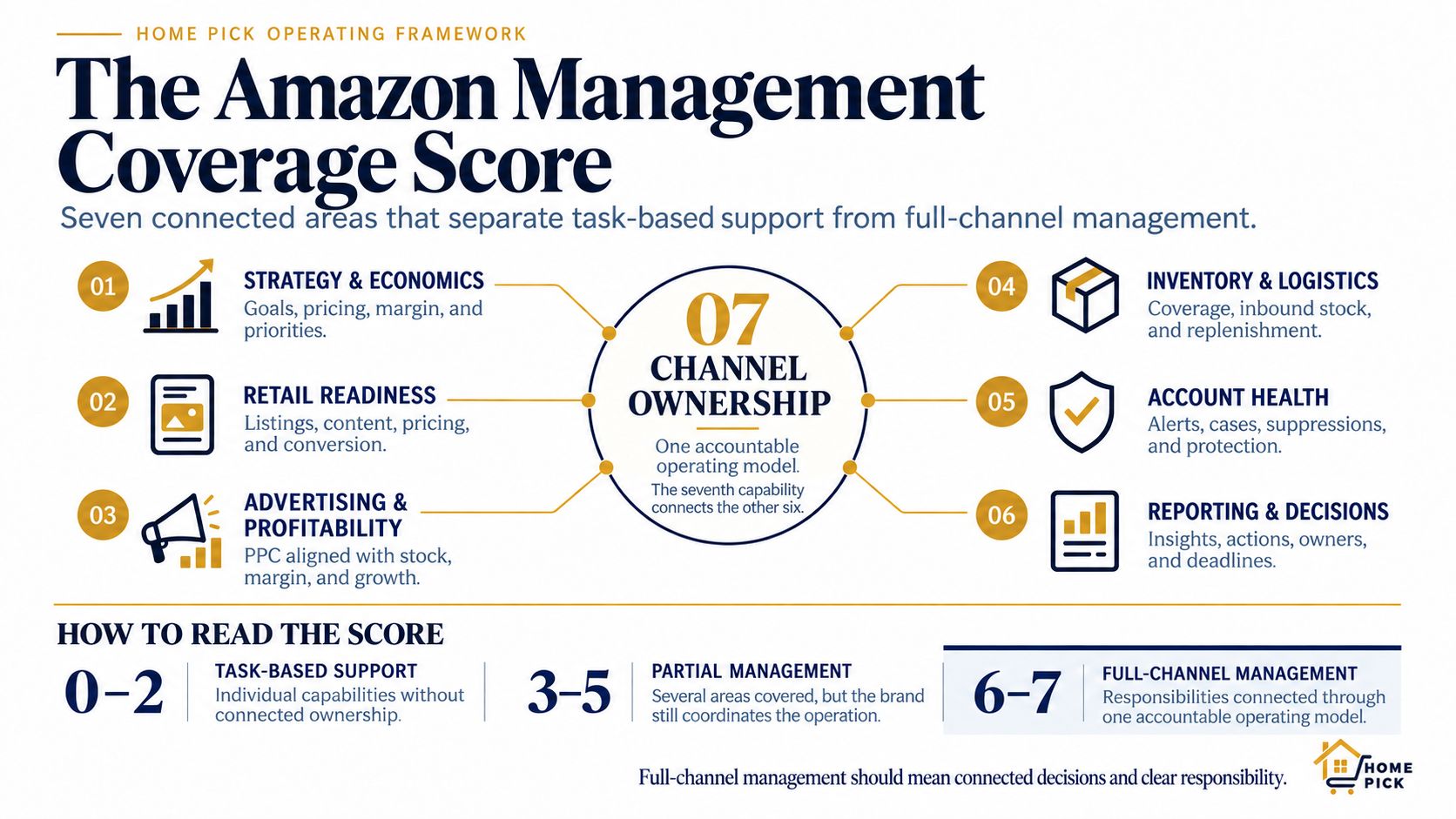
1. Is There a Commercial Strategy Behind the Activity?
Account management should begin with the brand’s economics and objectives.
The provider should understand margin, pricing constraints, priority products, category position, inventory capacity, and growth expectations. These inputs determine where advertising investment belongs and which products are commercially ready to scale.
More activity does not automatically produce a healthier channel.
2. Is the Retail Foundation Ready to Convert?
Listings are not a one-time setup project.
Complete management should monitor titles, bullets, imagery, A+ Content, variations, pricing, buyability, catalog accuracy, and conversion performance. When these elements are weak, advertising can generate additional traffic without generating enough incremental sales.
Retail readiness must be reviewed as competitors, customer expectations, and marketplace conditions change.
3. Is Advertising Connected to Margin and Inventory?
PPC management is only one part of operating an Amazon account.
Campaign decisions should reflect conversion, product margin, available inventory, promotional plans, organic performance, and the role of each ASIN. Increasing spend on a low-stock or low-margin product may improve advertising metrics while creating a wider commercial problem.
The question is not only, “Is ACoS improving?” It is, “Is advertising supporting profitable channel growth?”
4. Does Someone Own Inventory Risk?
An account manager may not control manufacturing or freight, but the Amazon team should understand stock coverage, inbound timing, FBA availability, lead times, and replenishment risks.
Descartes Sellercloud’s Amazon inventory management guide demonstrates how FBA, FBM, reserved, inbound, stranded, and unsellable inventory create greater complexity as a business scales.
If inventory is not included in performance discussions, account management is incomplete.
5. Are Account Health Issues Managed Proactively?
Policy notifications, suppressed listings, stranded inventory, catalog errors, Seller Support cases, Brand Registry permissions, and unauthorized sellers can all affect performance.
The provider should define who monitors these issues, how they are escalated, and what requires input from the brand. Waiting until a problem affects revenue is not a sufficient account-health process.
6. Does Reporting Produce Decisions?
A dashboard is not a management system.
Useful reporting should connect revenue, advertising, conversion, profitability, inventory, and account risks. DataHawk’s Seller Analytics Dashboard guide similarly brings sales, advertising, traffic, profitability, and inventory into one operating view.
Every review should end with priorities, actions, responsible owners, and deadlines.
7. Who Actually Owns the Channel?
This is the decisive question.
Specialists may manage different areas, but one team must connect the information and coordinate execution. The brand should know who identifies the priority, makes the recommendation, assigns responsibility, and follows the issue through to resolution.
Home Pick’s Amazon services and full-channel operating model are built around connected channel ownership rather than isolated task delivery.
Calculate Your Amazon Management Coverage Score
Give your current operating model one point for each of the seven areas that meets all four of the following conditions:
- A clearly responsible owner
- A documented review process
- Defined actions and escalation paths
- Visibility for leadership
Use this simple interpretation:
- 0–2 points: Task-based provider
Your team is purchasing individual capabilities. - 3–5 points: Partial account management
Several areas are supported, but the brand still connects the operation. - 6–7 points: Full-channel management
Responsibilities are connected through one accountable operating model.
A high score does not mean one person performs every task. It means no critical responsibility is left unowned.
For a practical example of how these areas should work together under pressure, review Home Pick’s guide to Amazon channel readiness before peak season.
Full Service Should Mean Full Visibility and Clear Responsibility
Brands should not evaluate Amazon account management services only by comparing deliverables.
Ask what remains with your internal team. Ask who owns inventory risk, catalog problems, advertising priorities, account health, reporting, and the weekly action plan. Ask how decisions move from insight to execution.
If the answer is unclear, the brand may still be managing Amazon—even after hiring an agency.
Frequently Asked Questions
1. What should Amazon account management services include?
Complete services may include strategy, Seller Central management, catalog and listing optimization, advertising, inventory coordination, account health, brand protection, reporting, and growth planning.
2. What is the difference between account management and PPC management?
PPC management focuses on advertising. Account management should connect advertising with pricing, listings, inventory, profitability, account health, and wider commercial objectives.
3. Should an Amazon account manager monitor inventory?
Yes. The manager may not control production or freight, but should monitor availability, inbound inventory, lead times, sell-through, and replenishment risk.
4. Can an internal team manage Amazon effectively?
Yes, provided the team has sufficient expertise, capacity, data access, and clear ownership across all critical areas. External support becomes valuable when those capabilities are missing or fragmented.
5. How should a brand evaluate an Amazon management agency?
Evaluate its operating process, category experience, reporting cadence, inventory awareness, escalation procedures, scope of responsibility, and evidence of execution—not only its service list.
Are You Still Managing Your Amazon Agency?
If your internal team continues coordinating advertising, listings, inventory, reporting, and account issues, Home Pick can help identify where channel ownership is breaking down.
Request a Free Amazon Brand Audit and receive an initial review of your Amazon presence and key improvement opportunities.


