


A scheduled deal is not automatically a profitable promotion.
For established brands, reviewing Amazon Black Friday deals means checking more than the discount. The promotional price must support the economics, available inventory must support demand, and someone must own execution when conditions change.
Before approving or scaling a promotion, review four areas: contribution after promotional costs, usable stock, current program requirements, and decision ownership. Apply these checks to both proposed and already scheduled promotions. Do not assume enrollment remains open or that a previous submission confirms the current status.
The objective is not simply to sell more units. It is to understand what those sales contribute and whether the operation can support them.
Amazon Black Friday Promotion Checklist
Review each participating SKU separately. A strong product can still be a weak promotional candidate if its margin, stock coverage, or execution plan is unclear.
Use this checklist in a shared review, recording the evidence, next action, and responsible person for each item.
1. Check Profitability After the Discount and All Relevant Costs
Start with the price the customer will actually pay, not the regular selling price.
For each SKU, estimate contribution after product cost, applicable referral and fulfillment fees, logistics, promotion charges, advertising, and expected return-related costs. Use a consistent allocation method and avoid counting costs twice.
A practical planning calculation is:
Estimated promotion contribution = promotional sales revenue − product costs − applicable Amazon and logistics costs − promotion charges − advertising spend − expected return-related costs.
This is a contribution estimate, not necessarily net profit. Business overhead and other costs may sit outside the calculation.
If revenue already uses the discounted selling price, do not subtract the discount again. Likewise, do not deduct freight separately if it is already included in your landed product cost.
Where a promotion has a fixed charge, test how different sales volumes affect the result. Spreading that charge across an ambitious unit forecast can make the economics look stronger than they are.
Build a baseline and a downside scenario. What happens if advertising costs more, fewer units sell, or returns exceed expectations? A promotion should have a clear commercial objective and an acceptable downside before the team commits.
2. Match Promotional Demand With Usable Inventory
Available inventory and inbound inventory answer different questions.
Available stock supports sales now. Inbound units only support the plan when they become usable. Review expected availability rather than relying solely on a delivery estimate.
For each promoted SKU, compare sellable units with expected demand throughout the promotion and the period before replenishment. Include ordinary sales alongside promotional demand; both draw from the same stock.
Also consider what happens after the deal. Selling through inventory may meet a short-term objective while leaving the brand unable to support subsequent demand.
For a deeper SKU-level review, use our guide to Amazon FBA inventory management for the holiday season.
If stock coverage is uncertain, revisit the demand plan and advertising support. More traffic should not be the default response to a promotion that the inventory position cannot sustain.
3. Verify Current Deal Requirements and Promotion Status
Amazon seller promotions should be reviewed using the current information for the relevant marketplace, account, product, and promotion type.
Amazon’s Black Friday and Cyber Monday seller guide covers promotional planning, inventory preparation, and marketing. Use it for general preparation, then verify the applicable requirements and status in Seller Central.
If you are evaluating Amazon Lightning Deals for Black Friday, check the specific opportunity available to your account. Do not assume another promotion type has identical requirements, charges, or scheduling options.
For an existing submission, review the current status, participating products, promotional price, quantity settings where applicable, and any warnings or required actions. Check other active discounts to understand the final customer price and any applicable interactions.
Record when the review was completed and who checked it. Revisit the information before execution rather than treating submission as the final checkpoint.
If enrollment is closed, focus on reviewing scheduled promotions and options currently available to your account. Do not build the plan around an unconfirmed opportunity.
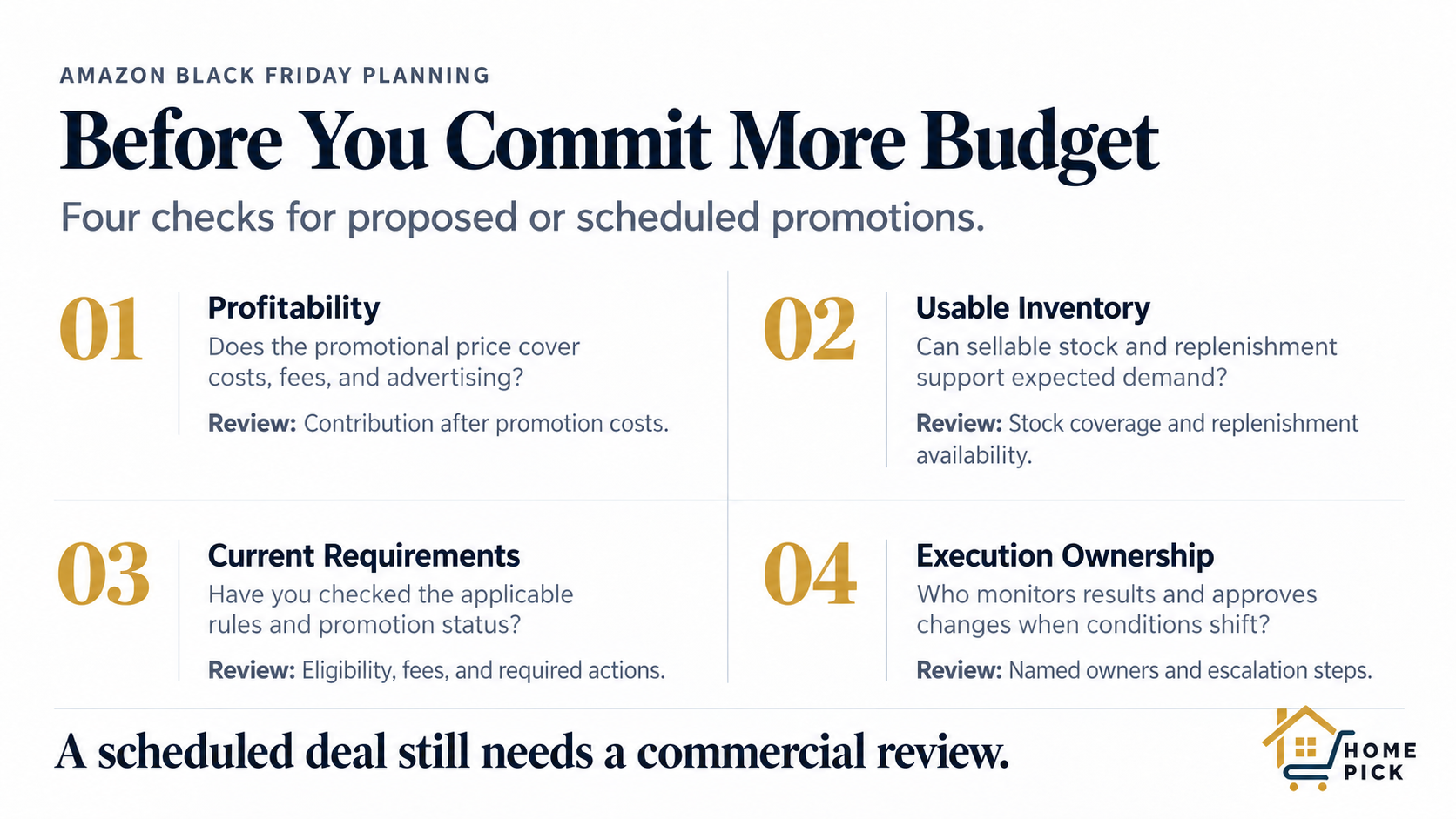
4. Assign Ownership Before the Promotion Runs
A promotion connects commercial, advertising, inventory, and account decisions. Each team can complete its own task while the overall plan remains inconsistent.
Assign one channel lead to coordinate the review, with named owners for pricing, stock, campaigns, and account issues. Agree on who can approve changes and how exceptions are escalated.
Define what the team will monitor: sales, contribution estimates, advertising spend, stock coverage, and promotion status. Set a review cadence and decision boundaries appropriate to the campaign.
Afterward, compare the result with the original assumptions. Separate revenue from contribution, and avoid treating every promotional sale as incremental demand.
Home Pick’s Amazon channel management services connect strategy, retail execution, advertising, inventory coordination, and reporting. The value is coordinated decisions, not simply more promotional activity.
Frequently Asked Questions
What should sellers check before running Amazon Black Friday deals?
Review SKU-level profitability, usable inventory, current program requirements, and execution ownership. Confirm the promotion’s current status and document unresolved issues before committing additional stock or advertising.
Are Amazon Lightning Deals for Black Friday always worth running?
No. Evaluate the expected contribution, applicable charges, inventory position, and commercial objective. Eligibility alone does not establish that a deal is a good investment for your brand.
How do you calculate Amazon promotion profitability?
Start with promotional sales revenue and subtract the relevant product, Amazon, logistics, promotion, advertising, and return-related costs. Distinguish contribution from net profit and avoid subtracting the discount twice.
What if Black Friday deal enrollment is already closed?
Review scheduled promotions and the options currently available in your account. Confirm their requirements in Seller Central rather than assuming another program is available or offers equivalent benefits.
Should you increase advertising during a Black Friday promotion?
Only when the offer, stock coverage, and expected economics support the decision. Set a budget and review point, then adjust based on performance rather than increasing spend automatically.
Review the Plan Before Increasing the Commitment
A stronger Black Friday plan connects the discount to a commercial objective, inventory readiness, and accountable execution.
If one of those areas remains uncertain, identify the next action before adding more budget.
Book an Amazon Strategy Call with Home Pick to discuss your promotion plan, operational gaps, and the support your brand needs.


