


How to Manage Amazon PPC During Black Friday
A higher advertising budget is not a Black Friday strategy.
For established brands, Amazon Black Friday advertising should connect campaign performance with promotional pricing, inventory availability, and contribution. More traffic only helps when the offer can convert and the business can support the resulting orders.
Manage Amazon PPC in three stages: prepare products and spending boundaries before the event, review performance alongside operational constraints during it, and reassess results and settings afterward. The right decision may be to increase, maintain, reduce, or redirect spend.
This guide focuses on making those decisions, not applying a universal budget increase or chasing sales without understanding their cost.
Before Black Friday: Build the Commercial Plan
Choose products that can support additional demand
Start with a shortlist of products, not an instruction to increase every campaign’s budget.
Review each product’s selling price, promotional terms, listing quality, sellable inventory, and replenishment outlook. A historical bestseller may be a poor advertising priority if its discount leaves insufficient contribution or its available stock is already committed.
Distinguish stock available for sale from units still moving through replenishment. For a deeper review, see our guide to Amazon FBA inventory management for the holiday season.
For each priority SKU, document the commercial objective, inventory constraint, and person responsible for resolving issues. This gives the advertising team a practical basis for allocation.
Set an Amazon advertising budget around the economics
Start with the actual promotional selling price. Account for product costs, applicable Amazon and logistics costs, promotion charges, and expected return-related costs before deciding what advertising the offer can support.
Do not subtract the discount again if it is already reflected in revenue.
Define a target contribution and an approved test budget. Consider a downside scenario in which conversion weakens or customer acquisition costs rise.
ACOS measures advertising spend relative to attributed sales; ROAS measures attributed sales relative to advertising spend. Neither metric alone establishes net profit or proves that all attributed sales were incremental.
A target that works at the regular price may no longer work during a promotion. Review the economics before reusing a historical campaign target.
Prepare targeting, bids, and monitoring
Separate established performers from exploratory targeting so you can evaluate them against different objectives.
Review search terms, product relevance, bidding settings, placement adjustments, and any active automation. Avoid introducing multiple untested changes immediately before the event without a clear reason and a way to assess them.
Amazon’s holiday advertising optimization guide discusses targeting relevance, bid allocation, product detail pages, and budget pacing as distinct areas to investigate. Use those areas diagnostically rather than assuming every weak result needs more budget.
During Black Friday: Diagnose Before Adjusting Spend
An Amazon PPC strategy needs to distinguish a funding constraint from a conversion or commercial problem.
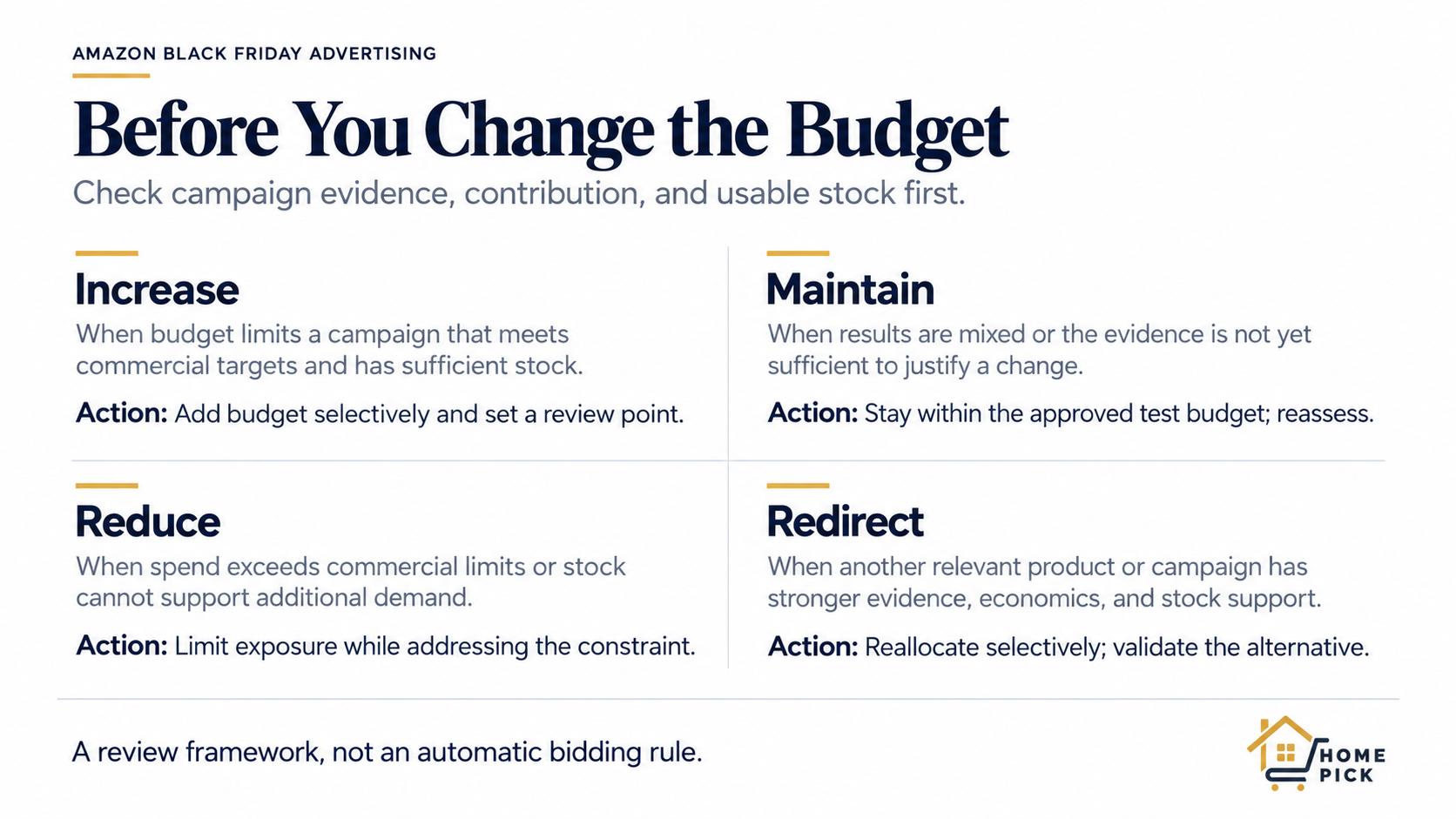
If a campaign runs out of budget, review whether its results, stock position, and contribution justify additional investment. Running out of budget shows a spending constraint; it does not establish that the next dollar will be profitable.
If clicks increase without a corresponding improvement in orders, examine the search terms, offer, price, delivery expectations, and listing before increasing bids.
For Amazon PPC bid optimization, focus on the targeting and placements behind the result. A campaign-level average can hide stronger and weaker areas.
Use the following framework as a review aid, not an automatic bidding rule.
An alternative product should earn its budget through its own relevance and economics. Do not redirect spend simply because another SKU has more stock.
Keep Daily Reviews Connected to the Business
Assign a channel lead to connect advertising decisions with pricing and inventory updates. Name who can approve budget changes, revise bids, and escalate product availability issues.
Review spend, clicks, conversion, attributed sales, contribution estimates, and stock coverage together. Set the review cadence according to the campaign’s pace and financial exposure.
Treat very recent results as provisional. Check the applicable reporting and attribution definitions before interpreting a short-term change as a final outcome.
Keep a change log with the observation, action, owner, and next review time. This helps distinguish a deliberate test from a series of reactive adjustments.
For example, if spend rises while stock coverage falls, the question is not simply whether ACOS remains acceptable. The team must decide whether additional demand supports the broader inventory plan.
After Black Friday: Reassess Before Carrying Spend Forward
Review temporary budget increases, bidding changes, and promotional assumptions. Do not leave event settings in place by default once pricing or demand conditions change.
Reconcile advertising reports with product sales, promotion costs, and inventory movement. Revisit the analysis when the relevant reporting period is sufficiently complete.
Separate branded demand, non-branded acquisition, and exploratory activity where the available reporting supports that distinction. Their roles differ, and one blended result can obscure useful decisions.
Record which offers supported additional investment, which constraints limited performance, and which tests need more evidence. Compare outcomes with the original assumptions rather than judging the event only by revenue.
Home Pick’s Amazon channel management services connect advertising with retail execution, inventory coordination, and reporting. That coordination helps brands evaluate the channel rather than managing campaigns in isolation.
Frequently Asked Questions
Should I increase my Amazon PPC budget for Black Friday?
Not automatically. Increase selectively when campaign evidence, product economics, sellable stock, and approved spending limits support the decision. An exhausted budget alone is not enough.
What is a good ACOS for Amazon Black Friday advertising?
There is no universal target. Set it using the promotional price, relevant costs, desired contribution, and campaign objective. A lower ACOS does not automatically mean greater total profit.
Should I increase bids or campaign budgets?
They address different constraints. A budget change concerns available spending capacity; a bid change concerns auction participation and potential click costs. Diagnose the constraint before changing either.
How should inventory affect Amazon PPC decisions?
Review sellable stock and replenishment timing alongside expected demand. Limit additional demand for constrained products, and assess alternative products individually before redirecting investment.
When should I evaluate Black Friday campaign results?
Monitor during the event for operational decisions, then revisit performance after the applicable reporting and attribution periods. Do not treat same-day figures as the complete commercial result.
Connect Advertising Spend With Channel Readiness
A stronger Black Friday plan gives each budget decision a commercial reason, an accountable owner, and a review point.
If campaigns, margins, and inventory are being managed separately, fix that coordination before treating more spend as the answer.
Book an Amazon Strategy Call with Home Pick to discuss your advertising plan, operational constraints, and the support your brand needs.


