


Your UK success is a starting point. Your US investment needs its own business case.
Strong Amazon UK sales tell you something valuable: your products have found customers, your team has operating experience, and your offer works in an established market. They do not prove that the same assortment, pricing, listings, and advertising plan will produce comparable results in the United States.
For established brands comparing Amazon UK vs US, the commercial question is not simply whether expansion is possible. It is which parts of the UK strategy can transfer, which assumptions need testing, and how much investment those tests justify.
This applies whether you are preparing your first US launch or already selling on Amazon.com without the traction you expected.
Amazon UK vs US: What Needs Revalidating?
Treat the US plan as a set of commercial assumptions to validate, rather than a copy of the UK operation. Differences depend on your category, product, and fulfillment model.
1. Validate the Offer, Not Just the Market
A large marketplace does not automatically create an attractive opportunity for your specific product. Start by examining the offers customers would realistically compare with yours.
Review relevant search results, competing pack sizes, pricing, product presentation, and recurring themes in customer feedback. Look for a defensible reason to choose your offer, not simply evidence that the category sells.
Your UK bestseller deserves consideration, but it should not automatically receive the largest US inventory commitment. Another SKU might offer clearer differentiation, more manageable fulfillment costs, or a stronger starting margin.
Create a shortlist of candidate products and document the evidence supporting each. Where the evidence is weak, define what needs testing before committing more stock.
2. Rebuild the Economics Before Setting the Budget
Converting your UK retail price into dollars is not a US pricing strategy. The selling price must make sense against local alternatives while supporting your actual cost structure.
Model product cost, freight and preparation, applicable import costs, marketplace and fulfillment fees, storage, expected returns, promotions, and advertising. Include partner or management costs where relevant, and avoid counting the same cost twice.
Use Amazon’s current selling plans and fee information as an input, not a substitute for a SKU-level calculation. Actual costs depend on factors such as category, product characteristics, and fulfillment choices.
Build a baseline and a less favorable scenario. If the proposed offer only works with optimistic advertising costs or an untested premium price, that uncertainty should affect the budget.
Illustrative scenario: A UK bestseller depends on a multipack to support its margin. In the US, competing offers emphasize smaller entry packs. Copying the multipack might protect unit economics but make customer acquisition harder. Testing a different format could improve accessibility while changing fulfillment costs and replenishment needs. The decision requires a commercial calculation, not just a listing edit.
3. Adapt the Listing to the Purchase Decision
Existing UK content can provide useful assets, but changing spelling is not enough to establish relevance.
Review how customers describe the problem, which benefits competing listings emphasize, and what questions remain unanswered. Then decide whether your title, images, bullets, and product explanation address those priorities clearly.
Keep brand identity consistent while adapting the evidence supporting the purchase. A product demonstration may deserve more prominence than a brand-story image; pack size or usage instructions may need clearer explanation.
These are hypotheses to validate, not universal claims about American shoppers. Avoid rewriting everything without identifying what each change is intended to improve.
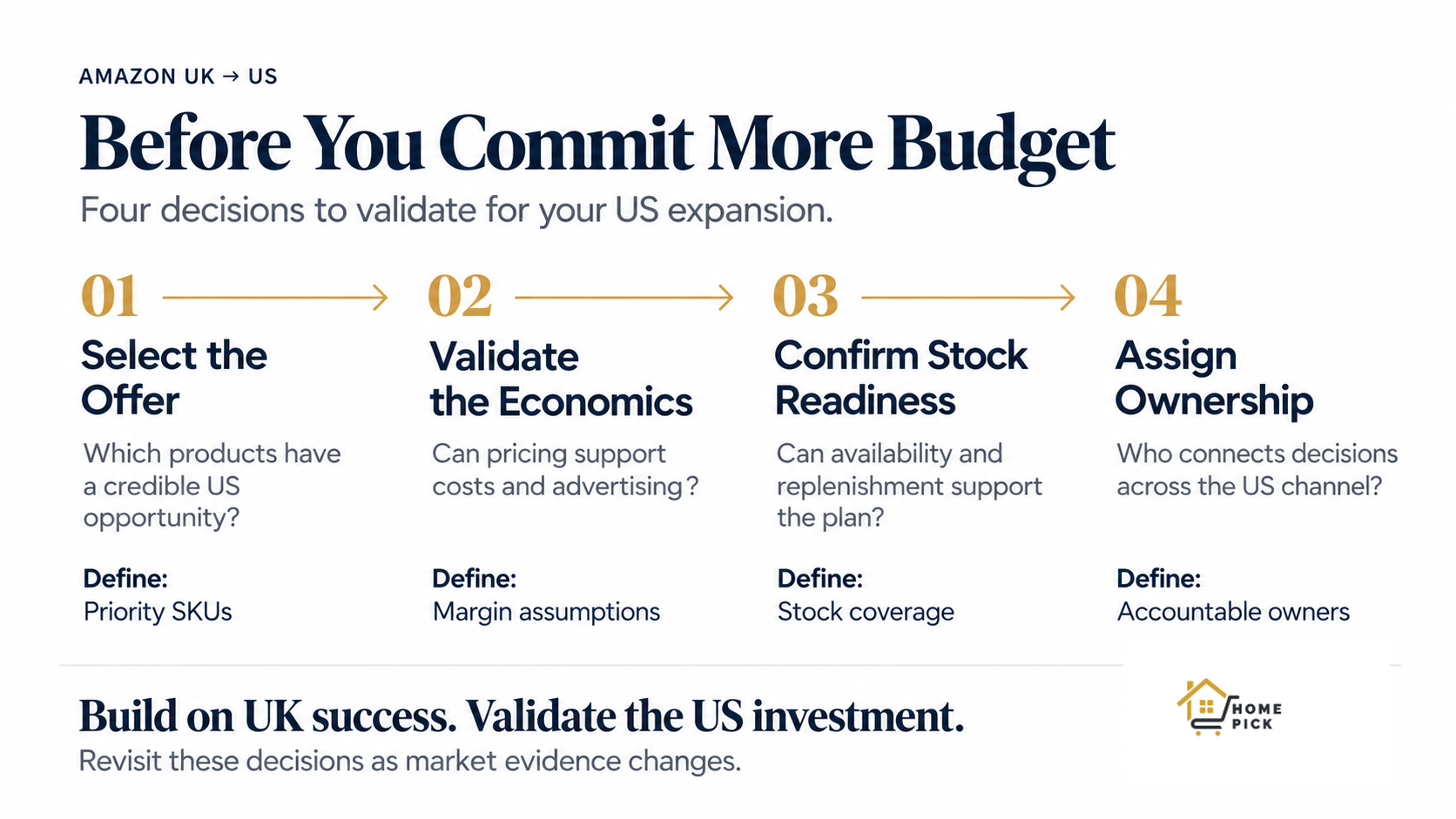
4. Connect Advertising Tests With Inventory Readiness
A campaign cannot be evaluated properly in isolation from the offer it promotes. Price, listing clarity, product availability, and delivery expectations all belong in the review.
Before increasing spend, establish which SKUs have sufficient stock coverage and when replenishment can support additional demand. An incoming shipment alone is not proof that inventory will be usable when needed.
Define what the initial advertising test should reveal: relevant traffic, purchase response, and whether acquisition costs fit the commercial model. Set a review point and a budget boundary rather than assuming the UK campaign structure will transfer unchanged.
If US traction is weak, investigate the constraint before increasing spend. The next action may be a listing change, a different product selection, or improved availability rather than more traffic.
5. Choose Support Around the Operating Gap
Some brands already have the people and capabilities to manage the US channel internally. Others need specialist help with a defined task. An operating partner becomes more relevant when decisions across listings, inventory, advertising, and reporting require coordinated ownership.
Before choosing support, identify who approves pricing, adjusts campaigns, monitors stock, and resolves conflicting priorities. A service list does not answer those questions.
For the broader market-entry process and operating-model options, see our guide to selling on Amazon USA from the UK.
Home Pick’s Amazon channel management services connect strategy, retail execution, advertising, inventory coordination, and performance visibility. The relevant question is whether that support addresses your brand’s actual operating gap.
Frequently Asked Questions
What is the main difference between Amazon UK and US for an established brand?
The key difference is the commercial context surrounding the offer. Competitors, customer expectations, costs, and execution requirements need local validation; UK performance does not establish the US business case.
Should we launch our best-selling UK products first?
Use UK performance to create a shortlist, not an automatic launch order. Compare differentiation, local demand, margin, and replenishment requirements before selecting the first US SKUs.
Can we reuse our UK Amazon listings?
You can reuse relevant assets and product knowledge, but review search language, product presentation, and customer questions. Adapt content where there is a clear reason, while retaining consistent brand identity.
Are Amazon US advertising costs always higher than in the UK?
Do not assume they are. Costs and returns depend on the category, targeting, competition, and offer. Build US-specific assumptions and validate them through controlled tests.
When should a UK brand consider a US operating partner?
When internal capacity or fragmented responsibilities prevent coordinated execution. Evaluate the partner’s scope, decision ownership, reporting, and commercial fit rather than choosing solely on campaign-management capabilities.
Build the US Plan Before Increasing the Commitment
Expansion should have a clear rationale for product selection, pricing, inventory, advertising, and ownership. If one remains uncertain, define the next validation step before scaling the investment.
Planning your Amazon US expansion, or reassessing an existing launch? Book an Amazon Strategy Call with Home Pick to discuss your commercial assumptions, operational gaps, and the support your brand needs.


