



When growth slows in a brand’s home market, international expansion often moves higher on the agenda. The United States can appear especially attractive: it offers a large consumer market, and Amazon provides an established route for reaching U.S. shoppers.
But slower domestic sales do not automatically make Amazon USA the right next move.
The underlying issue may be market saturation, weaker category demand, pricing pressure, changing customer preferences, distribution problems, or gaps in the brand’s own execution. Entering another country can create a new growth path, but it can also transfer unresolved problems into a more competitive and operationally demanding market.
A sound Amazon international expansion decision should answer a more useful question: does the brand have a credible, commercially viable reason to enter the United States?
That decision requires evidence about demand, product fit, economics, inventory, and operating capacity. The objective is not simply to replace lost domestic revenue. It is to determine whether the U.S. opportunity can support sustainable growth on its own merits.
First, Understand Why Growth Is Slowing at Home
Before evaluating a new market, leadership should diagnose the current one.
Domestic growth can slow for very different reasons:
- The category may be maturing or contracting.
- The brand may have reached a high level of market penetration.
- Competitors may be improving their products, pricing, or distribution.
- The product portfolio may no longer reflect customer demand.
- Retail availability or inventory problems may be limiting sales.
- Marketing efficiency may have declined.
- The brand may be overly dependent on one channel or customer segment.
These causes do not lead to the same expansion decision.
If the brand has a strong product, healthy margins, reliable supply, and evidence that the domestic market has become structurally limited, diversification may be commercially sensible. If growth is falling because the offer has weakened or the operating model is unstable, entering the United States may multiply those problems.
Expansion should not be used to avoid diagnosing the core business. The brand should understand which strengths can travel and which weaknesses must be corrected first.
Build a U.S. Demand Thesis, Not a Revenue Hope
Home-market performance is useful evidence, but it is not proof of U.S. demand.
Customer expectations, search behavior, product formats, price points, claims, ingredients, packaging, and competitive standards can all differ. A well-known brand at home may begin in the United States with limited awareness and little marketplace authority.
A U.S. demand thesis should examine:
- Relevant category and search demand
- The products currently earning visibility and sales
- Common price points and pack configurations
- Review strength and customer expectations
- Promotional patterns
- Product differentiation
- Gaps that the brand can credibly fill
- Evidence of existing U.S. interest outside Amazon
Amazon’s own guidance on building a global market-entry strategy emphasizes the importance of evaluating customer demand, operational costs, and launch timing rather than choosing a new country on instinct alone.
The goal is not to prove that Americans buy the category. It is to determine why they would choose this brand, at a viable price, against the products already available.
Test the Economics Before Committing to the Market
Revenue potential can look attractive until the full cost of selling on Amazon USA is included.
The commercial model should account for:
- Manufacturing and packaging
- International freight and duties
- Preparation and domestic logistics
- Amazon referral and fulfillment fees
- Storage and aged-inventory exposure
- Returns and damaged inventory
- Advertising
- Promotions and discounts
- Content and launch preparation
- Partner or internal operating costs
The result should be evaluated through contribution margin, not gross sales alone.
Leadership should model more than one scenario. A base case can show what happens under reasonable demand and advertising assumptions. A more conservative case can expose the effect of slower conversion, higher acquisition costs, delayed replenishment, or heavier promotional pressure.
If the opportunity only works under an optimistic forecast, the brand does not yet have a durable U.S. business case.
Choose the Products That Fit the U.S. Opportunity
The home-market bestseller is not automatically the best U.S. launch product.
A leading domestic product may depend on local brand recognition, a familiar use case, a price structure that does not transfer, or retail habits that differ in the United States. Another product in the portfolio may have clearer differentiation, stronger margins, or a more attractive competitive position.
Each candidate product should be assessed against:
- Evidence of U.S. demand
- Competitive intensity
- Product differentiation
- Contribution potential
- Category and compliance requirements
- Retail readiness
- Inventory availability
- Replenishment reliability
- Strategic value to the wider brand
Launching the full catalog can spread inventory, advertising, and management attention too thinly. A focused initial portfolio gives the team a clearer way to test assumptions, concentrate resources, and learn from the market.
For the execution steps that follow this decision, see Home Pick’s guide to launching an international brand on Amazon USA.
Determine Whether the Brand Can Operate the Channel
Marketplace access is not the same as market readiness.
Amazon’s Global Selling resources outline ways for businesses outside the United States to reach U.S. customers. The commercial result still depends on how well the brand manages the channel after access is established.
Before launch, the operating model should define:
- Who owns the Amazon account and brand permissions
- Who validates product and category requirements
- Who localizes and maintains listings
- Who coordinates inventory and replenishment
- Who controls pricing and promotions
- Who manages advertising
- Who monitors account health and catalog issues
- Who connects reporting with commercial decisions
This is where many expansion plans become fragmented. One provider manages listings, another runs advertising, a logistics partner handles inventory, and the brand receives reports without one accountable channel owner.
An established brand does not only need market access. It needs a repeatable way to make decisions and resolve problems across the entire Amazon operation.
Decide What Role Amazon Should Play
Not every U.S. expansion needs the same ambition from day one.
Amazon may serve as:
- A focused channel for validating U.S. demand
- The first stage of a broader market-entry strategy
- A direct ecommerce channel supporting existing U.S. distribution
- A marketplace for a selected product portfolio
- A larger long-term growth channel requiring dedicated operating capacity
The intended role should influence the initial portfolio, inventory commitment, advertising budget, success criteria, and operating model.
If the purpose is validation, the plan should identify which assumptions must be tested and what evidence would justify further investment. If the goal is meaningful scale, leadership should be prepared to fund retail readiness, inventory, advertising, and ongoing channel management accordingly.
Without this clarity, the brand may launch with growth expectations but resource the initiative like a small experiment.
Use a Go, Pause, or Rework Decision
A practical market-entry review should lead to one of three outcomes.
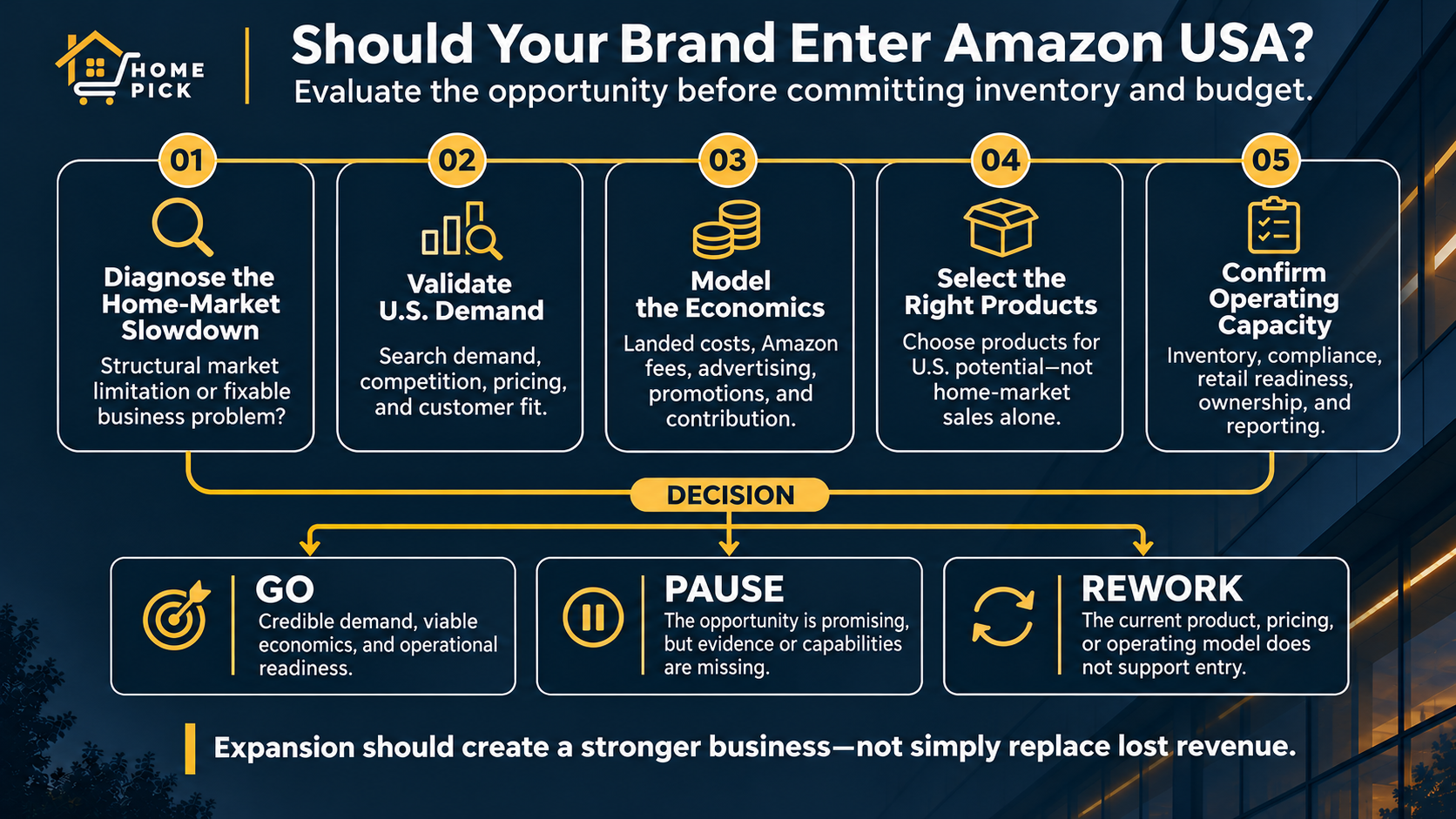
A pause is not a failed expansion. It is a decision to avoid committing capital before the business case is strong enough.
What Evidence Should Justify the Next Investment?
Entering the market is only the first decision. The brand should also define what must happen before it increases inventory, advertising, or portfolio breadth.
Useful evidence may include:
- Conversion that supports the product economics
- Repeatable demand across relevant search terms
- Stable availability and replenishment
- Customer feedback that validates the offer
- Contribution after advertising and promotional costs
- Clear performance differences between products
- Operational issues being resolved within an acceptable cadence
These are decision signals, not universal benchmarks. The thresholds should reflect the brand’s category, margins, objectives, and investment tolerance.
Reporting should show more than revenue and advertising metrics. It should explain what the market is teaching the brand and what action should follow.
Expansion Should Create a Stronger Business, Not Only More Activity
Slower home-market growth can be a valid reason to evaluate Amazon USA. It is not, by itself, a reason to enter.
The strongest international expansion decisions begin with a clear diagnosis of the domestic slowdown and a separate assessment of the U.S. opportunity. They connect demand, product selection, contribution, inventory, and operating capacity before the brand commits significant resources.
If those elements support one another, Amazon USA can become a credible new growth channel. If they do not, launching faster will not improve the underlying business case.
Home Pick’s Amazon services and full-channel operating model help established international brands evaluate the U.S. opportunity and build the operating model required to enter and manage Amazon USA. This can include market assessment, portfolio planning, retail readiness, inventory coordination, advertising, reporting, account health, and ongoing channel management.
Schedule an Amazon Strategy Call with Home Pick to assess whether the U.S. opportunity fits your brand, economics, and operating capacity.
Frequently Asked Questions
Can international expansion offset declining domestic sales?
It can diversify revenue and create access to new demand, but the result is not automatic. The brand still needs a commercially attractive U.S. opportunity, viable economics, suitable products, sufficient inventory, and a capable operating model.
Should a brand enter Amazon USA before fixing problems in its home market?
It depends on the cause of the slowdown. Market saturation may support diversification, while weak positioning, poor margins, inventory instability, or execution problems may also affect the U.S. launch. Leadership should identify which issues are market-specific and which could travel with the brand.
How should an international brand evaluate U.S. demand?
Review relevant search and category demand, leading products, price points, pack structures, reviews, promotional patterns, and customer expectations. The assessment should determine whether the brand offers a credible reason to buy and whether that demand can support viable economics.
Should the brand launch its best-selling domestic product first?
Not automatically. The strongest domestic seller may not have the best U.S. demand, differentiation, contribution, compliance profile, or inventory position. Products should be selected according to the target market rather than copied from the home-market ranking.
What should be ready before selling on Amazon USA?
The brand should have a validated opportunity, a focused product portfolio, modeled economics, confirmed product and category requirements, localized retail content, an inventory and replenishment plan, and clear ownership of day-to-day channel execution.


